Author: admin
-
Past Papers Reflection
I wrote my favorite papers of all time in my AP English class senior year of high school. I unfortunately no longer have access to these papers, but I remember receiving great praise from my professor, who was a former NYU professor (so I took her praise very seriously). My papers were on Jane Eyre and Beloved. My weakest papers are the ones I have written since starting college, I feel like my lowest efforts are rewarded or I am given a prompt that I cannot wrap my head around and too much freedom at the same time, which leaves me throwing together a haphazard paper that earns a B, and the whole time I’m not really sure it makes sense or is answering the prompt. When approaching analysis and writing, the papers I have felt most successful in are ones where I had weeks of preparation, either working with one or a couple texts towards a level of mastery. I also feel successful after working with many research texts and creating an annotated bibliography which helps me organize what each text is about and why it is important to my research. I feel like my analysis has improved since high school, but my writing has not. I have learned great writing skills in high school, and great research skills in college, but when it comes to writing in college, it is not at all what I was prepared for by AP classes, which had me convinced I would be hand writing essays in class in 45 minutes every other week, not typing by hand with weeks of time that I have to decide and time manage and get my work done on my own. I have produced some of my best writing under pressure/on the spot (with good knowledge/familiarity with my source material), and the only way I have been able to simulate that for college papers is waiting till the last minute, which is not something I want to do for a 15-20 page paper. I think research is difficult and time consuming, but it ensures a better end product, Nothing is really fun about writing/literary analysis to me except for getting it done, and I guess sometimes getting to share it or knowing you will share your ideas. -
Reading Response 7
For this assignment, I uploaded a pdf of Benson Jame’s article to Chat GPT with the prompt “summarize.” GPT generated this:
The article argues that Victorian medical texts often linked menopause and female reproductive changes to hysteria and mental instability, reinforcing the idea that women’s bodies were naturally unstable. (article) It examines how doctors such as Robert Barnes and Henry Maudsley described menopause as a “bodily crisis” that could cause psychological disorders, while also contributing to the belief that older women became socially redundant.
(article)
The author compares these medical views with Rhoda Broughton’s short story “Mrs. Smith of Longmains,” showing how the story satirizes and challenges these ideas by portraying a middle-aged woman whose supposed hysteria and irrational behavior ultimately save another woman’s life.
(article) The article concludes that Broughton’s fiction critiques the medicalization of women’s behavior and offers a counter-narrative that highlights women’s agency, intuition, and resistance to stereotypes about aging and madness. (article)
The “(article)s” are formatted like citations in GPT’s response, but they are just links to download the same article I sent to be summarized (lol). I think that it did a decent job summarizing the main idea of the essay, but it is definitely a very short summary compared to the length and detail of the reading. I think that my brief prompt likely influenced the AI to make the summary brief, and it is seemingly mostly ripped word for word from the abstract of the article. I’m not so sure that it got the argument of the reading correct in the first half, the author is not arguing that “Victorian medical texts often linked menopause and female reproductive changes to hysteria and mental instability, reinforcing the idea that women’s bodies were naturally unstable,” I think it is kind of a given that Victorian medical texts perpetuated ideas of instability surrounding women as relates to hysteria, menopause, puberty etc., the author is not arguing this but her argument is based off of this fact. I think the A.I. wrongly interpreted the first part of the abstract which is providing contextual information to the author’s argument and how male doctors of the Victorian era came to their conclusions. The second paragraph of the summary better captures the argument of the paper, but mistakes it for the “conclusion” deduced from the original argument the A.I. proposed. I could potentially see myself using A.I to summarize articles to see if they are worth reading in depth/if they will contribute to my research, but many academic sources online already come with summaries, or they have an “abstract” section which is the author’s own detailed summary of their work. I generally prefer not to use A.I if I can help it but I can understand how it might help consolidate time and work when creating my own academic journal/paper. -
Reading Response 6
Something that stood out to me in Winterson’s “Written on the Body” is the narrator’s expressed feelings of guilt or criminality for different reasons. There were several references in our reading I found, such as feeling like a “thief of stolen glances” when the narrator arrives in Louise’s home before her, and is observing the room and belongings as reflections of Louise and her life. Another example is the narrator feeling like a “jewel thief” for fondly remembering the line Louise said when she revealed that she was divorcing Elgin. There are also expressed feelings of feeling “naughty,” “guilty,” a “modest voyeur.” I thought that this self isolation or internalization of guilt by the narrator was very compelling and almost over-compulsive. The novel is driven by the narrators quick feelings, which are largely shame, guilt, or delinquent. The narrator only occasionally reminds themself that they are not alone in their “crime” or “sin” of adultery, but maybe there is more guilt/shame to be had from the homewrecker than the woman coming out of a stale marriage. The narrator’s emotions also change rapidly; from one moment treating Louise harsh or coldly for not divorcing her husband, having an STD, etc. and the narrator just starts suddenly going all in with what they want to say, before later regretting it and wishing they had chosen kinder words instead of immediately being on the offense against Louise whenever the narrator feels upset or disrespected. -
Reading Response 5
I found the poems that we read this week were intense and communicated the harsh reality for women considering having children or having an abortion. My attention was captivated by Brooks’ “the mother,” which deals with many heavy feelings, such as guilt (feeling like one has committed a crime, deliberation vs intentions), imagined potential (imagining the life their unborn child could have lived/loved/laughed, feeling as though one has poisoned the child’s life before it began), and yearning for the mother role (imagined motherly scenarios, gobbling mother-eye). Another part of the poem I found compelling was the choice to use physical descriptions of fetuses (damp small pulps with little or no hair) and word choices which invoke the imagery of post-partum activities or pregnancy/labor (contract, ease, breastfeeding, “you were born”). Brooks was so ahead of her time by depicting an unwanted/failed pregnancy and the emotions that a woman goes through- it is not simple, easy, happy, or convenient to go through something like this. In our contemporary I wish that these voices/perspectives were more widely understood or considered, but instead we have the opposite. In Tennessee, for example, abortion is already illegal, but recently there has been a law proposed which would make it so that women who have abortions can be charged with “fetal homicide” which is punishable by life in prison, life in prison without parole, or the death penalty. Jody Barrett, one of the lawmakers backing this bill, has a podcast where he has openly expressed his feelings on the issue, calling for a need for rule of law, rights for unborn children (“prebirth”), calls himself a “pro-life” advocate, and says that unborn children should have personhood from fertilization. His views conveniently ignore the emotional despair of women requiring abortions, the irony of being “pro-life” and calling for the death penalty, and the irony of worsening punishments for women without changing punishments for men who rape, engage in incest, “baby-trap,” or just straight up murder and abuse women. The actual crime of murder/manslaughter in Tennessee is only punishable by death or life in prison if there are aggravating circumstances or an abundance of proof, so certain lawmakers essentially want to make it so that abortion of an unborn fetus is a worse crime than murdering a fully grown and developed person with a life, family, kids of their own etc., while also carefully neglecting the fact that women who get abortions are not murderous criminals or blood thirsty people and rather just regular people getting a medical operation which comes with great deliberation and trauma, as depicted by Brooks. https://www.newschannel5.com/news/tenn-bill-overhaul-could-expand-homicide-laws-to-unborn-children
-
Reading Response 4
The end of Chopin’s “Awakening” was unexpected to me. I had hoped that Edna had a happy ending by getting a divorce and ending up with Robert, but instead we are left with tragedy and lack of closure. Despite taking place in the late 19th century, I thought that Edna’s tumultuous love life was weirdly “before its time,” which I guess is obvious considering it is a story of a woman taking back her agency and doing what she desires despite convention. From a modern angle however, it is clear what happened in this story:: A married woman gets “ghosted” by her side piece twice, won’t leave the man she is with, and has another side piece to replace the first one when he leaves for Mexican excursion. Despite all this unconventionality, there are many men and women like Edna and her counterparts, who freely live without conventions in modern romances. A driving factor in Edna’s malaise or sadness throughout the novel is Robert’s decisions to leave and not be together with her. Robert has self respect and can’t live his life a side piece, and Edna’s marriage complicates his feelings for her. He walks away whenever things get too serious between them, and Edna spends her time waiting for letters from him, reading other’s letters from him, and thinking of him. It is clear how Robert’s absence takes a toll on Edna’s mental health. Her behavior makes me think of how in modern times, people act similarly: when you are suddenly ghosted by someone, you want to check their profile, hear about what they are texting and saying to your friends, wonder what went wrong, etc. Ghosting drives people to essentially do emotional self harm and drive themself crazy over someone who they are infatuated with. The second time Robert “ghosts” Edna, it is much more personal and heartbreaking to her. Right when she thought they were becoming closer than ever and healing her old wounds, he disappears from her life again. At this point, her mental health has taken a great toll over time as well as from the immediate disappointment in the aftermath. Edna is exhausted of emotional energy and is driven to end her life. Of course there were many driving circumstances in her life and desire for agency which led to this, however Robert’s “ghosting” seemed like the nail in the coffin to me. Chopin’s depiction of mental health, “ghosting” partners, cheating/emotional cheating are, in my opinion, extremely modern for their time. Here is an article which helped me make this connection. https://www.msn.com/en-in/health/other/ghosting-rejection-and-more-how-modern-dating-can-take-a-toll-on-mental-health/ar-AA1Wrm5e
-
Reading Response 3
So far, I am enjoying my reading of “Awakening” by Kate Chopin. What has stood out to me the most so far is Mrs. Pontellier’s character and her withdraw from convention and tradition. Despite feeling empowered through her withdrawal (learning to swim, taking time for herself, spending time with those who make her happy), her quality of life and her relationships around her begin to crumble. I think this is a really interesting depiction of the journey of a woman reclaiming their independence. Edna’s story stands out because of the way her decisions and changes subvert her regular life, rather than creating immediate devastation or revolutionary change in her life. Her husband and children notice her absence, but everyone figures out how to get by without Edna around for one afternoon. She chooses to spend more time with Robert and flirting with him instead of rejecting advances, but her friend tells Robert not to tempt Edna, and Robert becomes more distant and eventually leaves entirely, despite the mutual admiration between him and Edna starting to grow. The reactions and actions of other characters seek to keep Edna in her state and slow down her “awakening,” whether they realize it is actually happening or not. This shows how the other characters in the story are abiders of and protectors of convention- they do not show great concern or care to Edna’s face, but in snide comments from her husband or private discussions without her, they are criticizing and concerned for Edna’s new behaviors. -
Reading Response 2
I really enjoyed both of our readings for this week. Starting with Prince’s “Tomboy,” I found myself relating heavily to the experience of the protagonist in discovering and presenting themselves as a “tomboy.” I have very similar memories of elementary school; wanting to play with the boys instead of girls, not getting along with “girly girls,” not accepting other girls as “tomboys,” not wanting to be labelled or questioned by others, confusing the adults. There was one time I sent out invitations to a birthday party, and one friend’s mom checked with their child to make sure he knew that I was a girl before accepting the invitation (and then awkwardly, shared this story with my mother on the phone). I also threw tantrums over not wanting to wear dresses or clothes with hearts and peace signs, in preference of Tony Hawk shirts and jeans. I thought that Prince did really well to capture the perspective of people who consider themselves “tomboys” that is more universal and common than tomboys themselves like to believe. “The Hidden Hand” tells a more heartbreaking story about survival and the struggles an orphan girl faces in achieving upward mobility in a world dominated by men. More appropriate to its time, the characters are stunned by the concept of a girl dressing and acting like a boy, but are sympathetic once they hear Capitola’s reasoning. Unlike a modern story like “Tomboy” however, Capitola must navigate a life where she is diminished as a girl, and perceived as a threat when considered a boy or son. Her story reminds me of “Jane Eyre,” who is more of a proto-feminist independent woman than a tomboy, but she must bear with the challenges of being an orphan, trying to establish economic stability/independence from others, inheritance battles, unwanted proposals, etc. Capitola’s story is unique however since it takes place with her as a young girl who is impoverished, whereas Jane Eyre went to boarding school and had fragile support from her remaining family before she could live independently. -
Reading Response 1
My biggest takeaway from reading Rosetti’s “Goblin Market” is my reading of Lizzie as a Christ-like or a substitute for a Christ-like savior to her sister. I had previously read this text in British Literature 2, but we analyzed their relationship more so through an LGBT/incestual lens rather than their bonding through their shared sin and trauma. I personally didn’t like focusing on this interpretation because I think it overshadows the struggle of Rosetti and other women in a patriarchal, Catholic society by trying to view it through a more modern angle. To me, the context of Rosetti’s devout Catholicism and the society she was brought in adds several layers of meaning to the relationship between sisters and particularly the sacrifice which Lizzie makes for her sister. Lizzie strives to do something good by purchasing fruit to bring to her sister, but finds out that this is not such a simple task, and it ends up coming at the cost of her “chastity” and bearing sexual trauma. She returns to Laura and says “Come and kiss me.
Never mind my bruises,
Hug me, kiss me, suck my juices
Squeez’d from goblin fruits for you,
Goblin pulp and goblin dew.
Eat me, drink me, love me;
Laura, make much of me;
For your sake I have braved the glen
And had to do with goblin merchant men.” This reminded me of Catholic rituals and writings involving the blood and flesh of Jesus, and how consuming him was in a sense, trusting him and the sacrifice he made for the Catholic’s sins. Similarly, Lizzie makes a sacrifice and “braves the glen” so that her sister can feel absolved of her own depravity or lost innocence at the hands of the goblin men (mentally) and physically in the sense that she recovers from her illness by consuming the fruit juices, with the help of her sister and not deceitful goblins who were tempting and manipulating her. -
Introductory Post
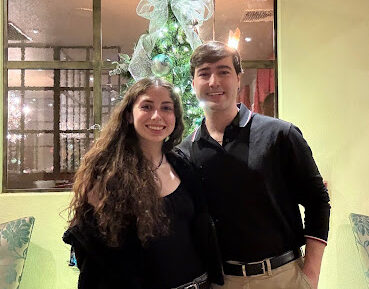
Hello there, my name is Samantha Villalobos and I am a junior at Rowan University majoring in English and Education. English as a subject has always been one of my strongest, I have always had an affinity for reading and writing. I realized I wanted to pursue education one day in a high school English class (taught by a Rowan alum, coincidentally) as I was imagining what kind of writing prompts and assignments I would want to give to students of my own. I am, admittedly, not as big of a reader as I used to be or wish I was, but I used to be a big consumer of horror and mystery novels like Goosebumps or works by Stephen King. Nowadays, my reading is mostly limited to the readings I am assigned by my professors and the news, with The New York Times being my preferred outlet. My plans for the future are to graduate from Rowan with a masters in Education and bachelors in English which I will use to teach English at the secondary level. I also imagine I will move to either the central or south Jersey area in order to be close to my boyfriend who is also pursuing a career as an educator.
As for our course this semester, I am hoping to take advantage of our seminar-style structure in order to expand my ideas and receive the opinions and ideas of others. This is one of the first courses I have taken where the classroom discussion is continuous and building off of itself, rather than students only directing their responses to the professor for participation credit. I am also hoping to finish this semester with an adequate paper that I can use in my portfolio and take pride in, since many of the papers I have written in my time at Rowan felt disingenuous or like I only wrote them for a grade (as opposed to public submission and potential publication). I feel motivated by the challenge this course proposes to me and I have a positive attitude towards completing it.